

CREATIVITY WITH PRODUCTION
HOW WE MADE IT: Episode 2
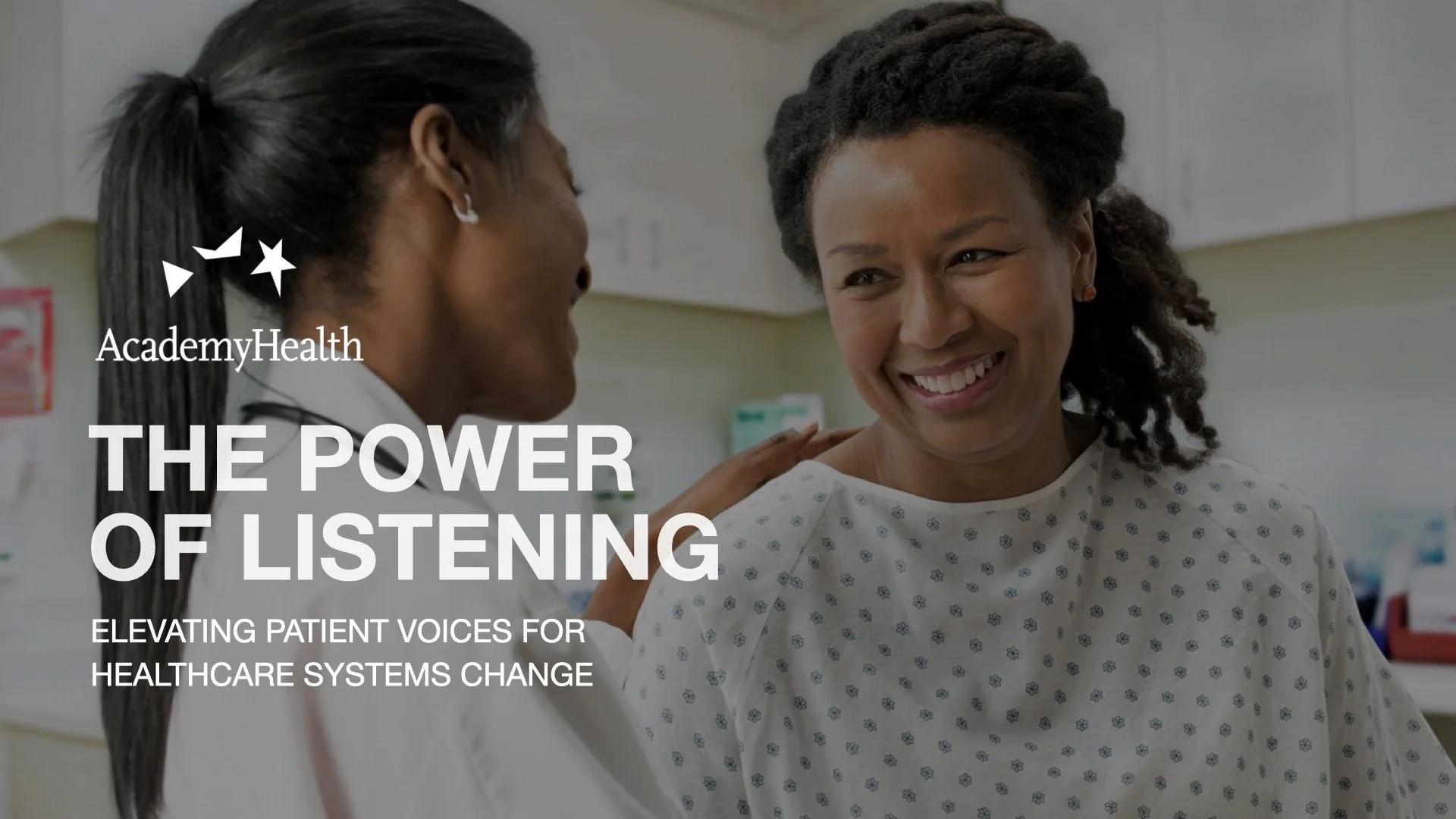
The Power Of Listening
Assignment
The communications team at AcademyHealth came to us to produce three videos presenting the findings from a series of Zoom focus groups conducted around the country with low-income patients. The topic of discussion was how the healthcare industry can better serve their needs.
The purpose for the videos was to provoke action from the AcademyHealth partner foundations and non-profits who work along with them to improve the healthcare system.
Sounds pretty straightforward. Here’s the catch.
They only had the rights to use the statements from the group respondents.
Ok, we love a challenge.
Creativity
This presented some interesting creative challenges. Our point of view given the specific audience was we had to step outside the lines and authentically connect on an emotional level. They are inundated with PowerPoints full of facts, statistics and videos made from stock footage. Our goal was to make them feel the emotion in what was being said. The driving asset for this project were the voices, and they needed to be front and center. So, the usual immediate go to of stock footage and infographics felt like a distraction. A dis-service to both AcademyHealth and the focus group respondents who opened up and shared their personal, negative experiences and interactions.
But we needed something for viewers to see. This isn’t a Podcast.
How do we make the voices the main visual?
Production
Let the limitation provide the answer. Voices… a voice sound wave, an audio EKG. This became the central element directing viewer’s attention to what is being said. Next, how can we use stock footage in a way that doesn’t distract viewers attention. Viewers naturally want to connect a voice to a face. We didn’t want that distraction. Powered by the animating voice sound wave we created a scrolling montage, a backdrop of visual synonyms that elicit the emotion of what is being said and the environment they live in.
Next challenge, the voices. For authenticity we had to get as real as possible. If this sounded like professional voice actors then why do it. We gave the statements to real people and had them read and record them on their own, undirected.
The overall look and feel we designed to be uncomfortable, distressed, a bit angry. For this series to accomplish the goal of provoking action it needed to be a cry for help.
Benefits Of Motion Design
Let’s write benefits for motion design? Or lose this section? I like each of our How We… to have some summary.
As voice actors, our cast could double-up roles over the series, acting out several different characters, adding flexibility and diversity to our on-screen cast.
Since our environments would now be animated, we could set our stories wherever we wanted and no longer be constricted by the cost and practicality of locations.
Some clinical information could be presented using abstract visuals within the films – such as demonstrating work / life balance within a circle.
Information could be adjusted more easily in development. Scripts could be more fluid, requiring only audio changes, and modifications to character and appearance could be made at late stages.
These were after all clinical films, advising and imparting information. Without so much visual “clutter” of real-life actor’s personalities and locations, viewers might focus more intensively on the information imparted.
The Results
We don’t have results yet. The three videos where edited together and submitted to the New York Times Op-Doc.